LOTOS EDGE:
Продвинутые опционы
Возможности опционной торговли выходят далеко за пределы покупки Call и Put. Комбинируя контракты с различными страйками, сроками экспирации и характеристиками, трейдер может создавать десятки стратегий, каждая из которых предлагает собственный способ работы с рынком.
Рост или падение цены, боковое движение, высокая или низкая волатильность, течение времени — каждый из этих факторов открывает возможности для применения различных опционных стратегий. Одни позволяют получать премию, другие рассчитаны на изменение волатильности, третьи дают возможность извлекать прибыль из временного распада или движения базового актива в определённом диапазоне.
Особую привлекательность опционам придаёт свобода конструирования. Трейдер может сочетать контракты, изменять соотношение потенциальной прибыли и риска, выбирать точки безубыточности и формировать позицию в соответствии со своим рыночным прогнозом. Такое разнообразие требует математической точности, глубокого понимания инструмента и способности оценивать последствия каждого решения.
Не менее важна работа с уже открытыми позициями. Если рыночная ситуация развивается вопреки ожиданиям, сложные опционные конструкции предоставляют дополнительные способы управления сделкой. Корректировка страйков, изменение сроков экспирации, добавление или закрытие отдельных контрактов позволяют пересматривать структуру позиции и её риск-профиль с учётом новых условий.
LOTOS EDGE продолжает образовательную систему LOTOS START и предлагает углублённое практическое изучение опционных стратегий. В основе программы лежит взаимосвязь рыночного анализа, математической логики и торговых решений. Ты научишься понимать, почему определённая стратегия подходит для конкретной ситуации, как правильно построить позицию, оценить её риски и управлять ею на протяжении всей сделки.

ИСКУССТВО И НАУКА ОПЦИОННОЙ ТОРГОВЛИ.
В основе LOTOS EDGE лежит глубокое понимание опционной торговли и практическое применение знаний в реальных рыночных условиях. Обучение строится вокруг конкретных торговых задач, требующих анализа, точных расчётов и самостоятельного выбора решений.
В процессе обучения ты будешь разбирать рыночные ситуации, рассматривать несколько возможных стратегий и сравнивать их по потенциальной доходности, вероятности успеха и уровню риска. Особое внимание уделяется пониманию того, почему одна конструкция может быть предпочтительнее другой, какие компромиссы предполагает каждый выбор и как оценивать его последствия.
Практическая работа включает анализ открытых сделок и принятие решений при изменении рыночных условий. Ты научишься оценивать целесообразность корректировок, рассчитывать их влияние на позицию и определять, когда сохранение первоначальной стратегии, её изменение или закрытие наиболее обоснованны.
Цель курса — развить профессиональное мышление, при котором каждое торговое решение опирается на понимание инструмента, анализ вероятностей и осознанное управление риском. Именно такой подход позволяет трейдеру самостоятельно работать со сложными опционными стратегиями и применять полученные знания в собственной торговле.
THE COURSE IS DESIGNED FOR:
Traders who want to explore themselves deeply throughout the trading process and understand what drives their own decisions, reactions, and recurring patterns of behavior.
The course will help you understand how you perceive the market, why money can change your state and behavior, which processes influence your actions, and why knowing what you should do is not always enough to actually do it.
This work is particularly valuable for traders who struggle with impulsive actions, fear of loss, excessive trading, attempts to immediately recover losses, breaking their own rules, or repeating behaviors whose consequences they already understand well.
For experienced traders, the course opens a different level of self-development — examining the quality of their own decisions, their relationship with risk and uncertainty, their professional standards, and the internal processes involved in managing capital.
COURSE CONTENT:
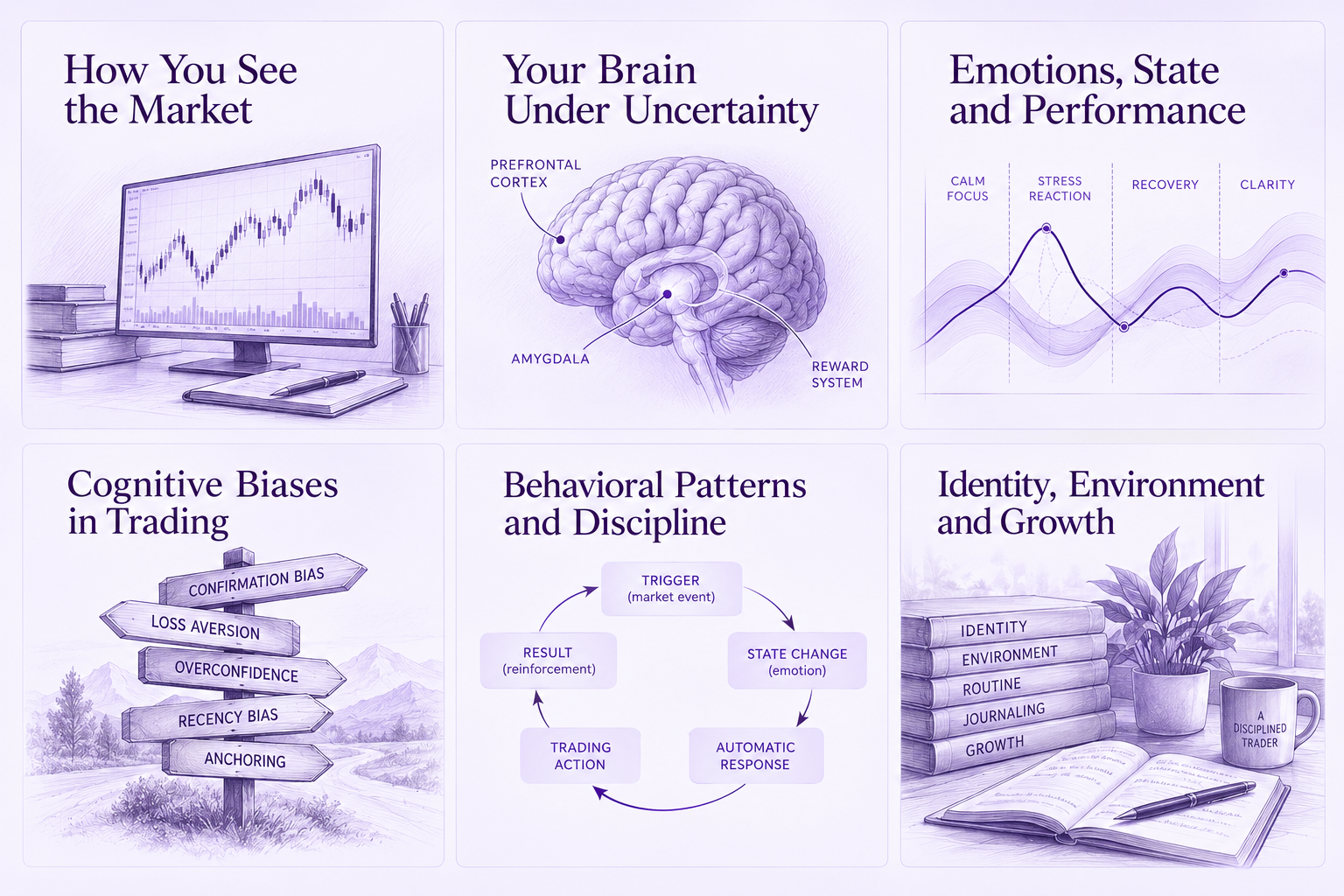
• Market perception and interpretation — facts, expectations, past experience, and individual perception of what is happening in the market;
• Money, risk, and the reward system — profits, losses, reward anticipation, and their influence on state and behavior;
• Cognitive processes in trading — attention, thinking, cognitive biases, and their role in the trading decision-making process;
• The trader’s state — the nervous system, stress, and the ability to maintain clarity of thought under pressure;
• Decision-making under uncertainty — probabilistic thinking, decision quality independent of trade outcome, and professional evaluation of one’s own actions;
• Behavioral patterns and discipline — the drivers of recurring behaviors, automatic responses, and the development of new behavioral patterns;
• Professional trader identity — the relationship with money, success, and loss, internal standards, and the development of a professional identity;
• Integration into a personal trading system — bringing together thinking, state, behavior, and professional standards in day-to-day trading.
COURSE STRUCTURE:
The course consists of 8 sequential Keys, each exploring a different aspect of trading psychology and progressively connecting it with what has already been learned.
Each Key includes:
• Video lessons with scientific explanations of the processes being studied;
• Extended learning materials for a deeper understanding of the subject;
• Self-assessment and exploration of personal reactions, decisions, and behavioral patterns;
• Practical assignments applying what has been learned to one’s own trading;
• Work with new behavioral patterns and their reinforcement over a seven-day period;
• Knowledge checks and tools for continued independent work.
The course concludes with the integration of what has been learned into a personal trading decision-making system.
LEARNING OUTCOMES:
After completing the course, you will be able to:
• Separate market facts from your own interpretation and recognize the influence of expectations and past experience on how you perceive the market;
• Understand your state, notice changes as they occur, and use specific tools to restore clarity, attention, and the ability to act in accordance with your strategy;
• Identify cognitive biases and understand how they manifest in your own trading;
• Examine recurring behavioral patterns, uncover what drives them, and systematically develop new ways of responding;
• Think in probabilities and separate the quality of your actions from the outcome of an individual trade;
• Understand your relationship with money, risk, profits, and losses and how it influences your trading behavior;
• Establish internal professional standards and develop yourself as a professional trader through your daily actions and choices;
• Use a practical set of tools to work with your thinking, state, and behavior and maintain the quality of your trading decisions under conditions of risk and uncertainty.
The course is available in English and Russian languages. Use the language selector at the top of the page to access the course page in your preferred language and complete your enrollment there.
A trading strategy can define what to do. It cannot determine the state, perception, and behavioral patterns you bring into each decision. These processes shape how consistently that strategy is actually executed. LOTOS INSIDE develops the part of the trading system that begins with the trader.
STUDY FORMATS:
LOTOS INSIDE can be completed independently or through individual mentorship.
THE INDEPENDENT FORMAT allows you to study at your own pace and apply what you learn directly to your trading practice. Self-assessments help identify individual patterns in thinking and behavior, while practical assignments provide a structured way to examine them within your own trading.
The course tools are designed to support work with your state, cognitive and behavioral patterns, and the gradual development of new ways of responding. Materials and practices can be revisited as your trading experience develops.
ENROLL SELF-PACED
THE INDIVIDUAL FORMAT complements the course with 8 private sessions with a psychologist, personalized guidance, and professional feedback. During the sessions, the results of self-assessments, observations, and practical work are explored in depth, while the course material is examined further through individualized analysis.
Particular attention is given to the processes most relevant to your own trading: your state and emotional responses, recurring behavioral patterns, relationships with risk, money, profits and losses, professional standards, and your development as a trader.
ENROLL WITH A MENTORFAQ:
Do I need trading experience to take this course?
Is the course applicable to different markets and trading styles?
Is the course suitable for an experienced trader who already has a trading system?
What makes LOTOS INSIDE different from other trading psychology courses?
How practical is the course, and how is the material applied to real trading?
What tools does the course provide for working with my state?
Will the course help me understand recurring mistakes and change habitual patterns of behavior?
Can I get the full value of the course through independent study?
What is the difference between independent study and individual mentorship with a psychologist?
How long does the course take, and how long will I have access to the materials?
STUDENT EXPERIENCES
⭐ ⭐ ⭐ ⭐ ⭐
I came into the course feeling that I knew my strategy well, yet I would still get in the way of executing it. The most valuable part for me was learning to understand my own state. I started noticing changes before they turned into impulsive decisions. My trading became much clearer and calmer.
— Elena M., Real Estate Agent
⭐ ⭐ ⭐ ⭐ ⭐
After several years of trading, I thought I understood my mistakes pretty well. The course showed me how often my decisions were shaped by expectations and past experience, even when I believed I was simply analyzing the market. I became much more aware of what I actually see on the chart and what I add to it myself.
— Michael R., Software Engineer
⭐ ⭐ ⭐ ⭐ ⭐
The biggest realization for me was seeing my recurring behavioral patterns. I had noticed the same mistakes in my journal before, but I treated each one as a separate event. For the first time, I could see the connection between the trigger, my state, and the action that followed. Once you understand the whole sequence, you can actually start working with it.
— Daniel K., Business Owner
⭐ ⭐ ⭐ ⭐ ⭐
The biggest change was in how I respond to money and losses. After a losing trade, I used to feel an urge to make the money back quickly, and that would affect my next decisions. The work in this course helped me recognize that process much earlier and separate the outcome of an individual trade from the quality of my actions.
— Anna P., Financial Analyst
⭐ ⭐ ⭐ ⭐ ⭐
I expected a course on trading psychology, but the work went much deeper into how I actually make decisions. It connects state, attention, thinking, behavior, and my relationship with risk. I now look at my trading as a system in which the trader is just as important as the strategy and the market.
— Robert S., Project Manager